The BD744 pinout is one of the most searched topics among electronics enthusiasts working with high-power PNP transistors. The BD744 is a PNP silicon power transistor housed in a TO-220 package, engineered for high-current, medium-voltage amplification and switching tasks. With excellent current capability and robust heat handling, it serves as a complementary device to the BD743 NPN transistor, together forming a powerful push-pull configuration for audio amplifiers and control systems.

Introduction to BD744 PNP Transistor
The BD744 transistor is designed for applications that require efficient current switching and amplification in the negative polarity domain. This PNP transistor is widely used in audio power output stages, motor control circuits, and power supplies. Its TO-220 package ensures good heat dissipation while maintaining a compact footprint suitable for both professional and hobby circuits.
With a collector-emitter voltage (Vce) of –45V, collector-base voltage (Vcb) of –50V, and a collector current rating of –20A, the BD744 can handle up to 90W of power dissipation. These specifications make it a reliable choice for circuits that demand both durability and consistent electrical performance.
BD744 PNP Transistor

Pinout of BD744

Understanding the BD744 Pinout Configuration
The BD744 pinout follows the same terminal layout as its complementary NPN transistor, BD743. Identifying the correct pin configuration is crucial for proper circuit design and installation. When facing the front side (text visible, leads downward), the pins are arranged in the Base–Collector–Emitter (B–C–E) sequence.
Pin Configuration of BD744 Pinout
| Pin# | Pin Name |
|---|---|
| 1 | Base |
| 2 | Collector |
| 3 | Emitter |
Key Features of BD744 Transistor
- High-current PNP transistor for power applications
- Suitable for both linear and switching operations
- Reliable complementary pair for NPN BD743
- Excellent thermal stability and power dissipation
- Designed for use in push-pull and class-AB amplifier stages
- Strong resistance to secondary breakdown
- Consistent DC gain performance under load
BD744 Transistor Datasheet and Specifications
- Collector–Emitter Voltage (Vce): –45V
- Collector–Base Voltage (Vcb): –50V
- Emitter–Base Voltage (Veb): –5V
- Collector Current (Ic): –20A
- Power Dissipation (Pc): 90W
- DC Current Gain (hFE): 25–100 (typical range)
- Package Type: TO-220
- Transistor Polarity: PNP
- Pin Configuration: Base–Collector–Emitter
- Junction Temperature (Tj): 150°C
Working Principle of BD744 Transistor
The BD744 transistor conducts current when its base is made more negative relative to the emitter, allowing a large current to flow from the emitter to the collector. This behavior makes it the PNP counterpart of the BD743, ideal for forming complementary amplifier pairs.
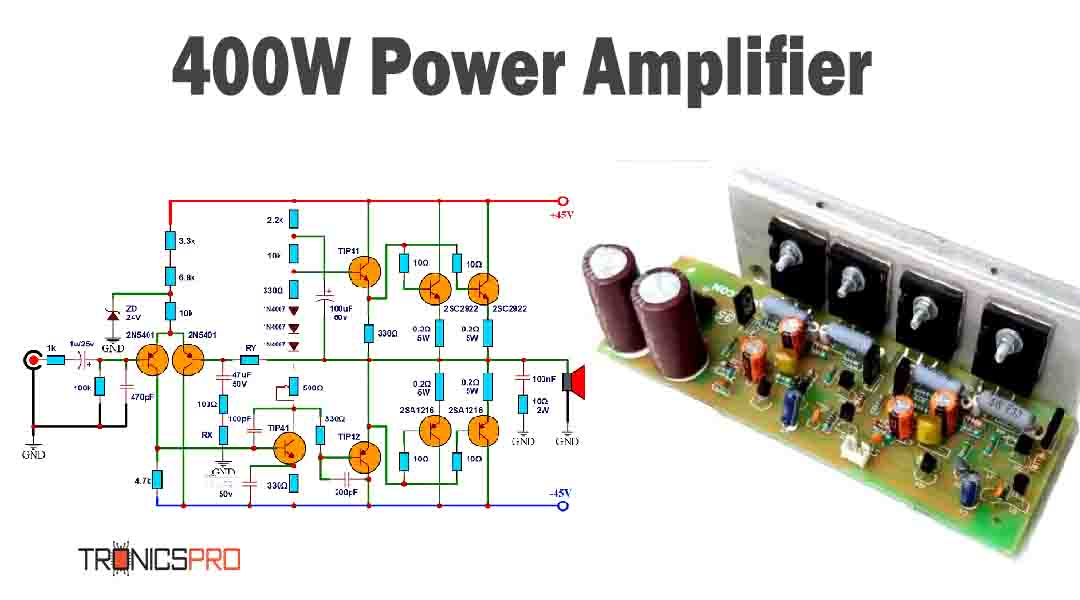
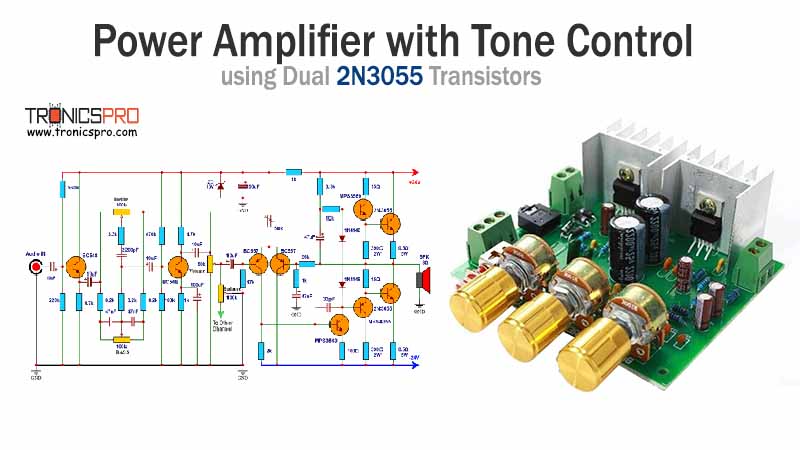
In amplifier circuits, the BD744 handles the negative half of the AC signal, while the BD743 handles the positive half, resulting in balanced output and minimal distortion. In switching circuits, BD744 effectively controls high-current devices like motors or solenoids with low base current input. Its robust silicon construction ensures long-term stability and consistent performance.
More Circuit Layouts


Typical Applications of BD744
- Audio power amplifier stages
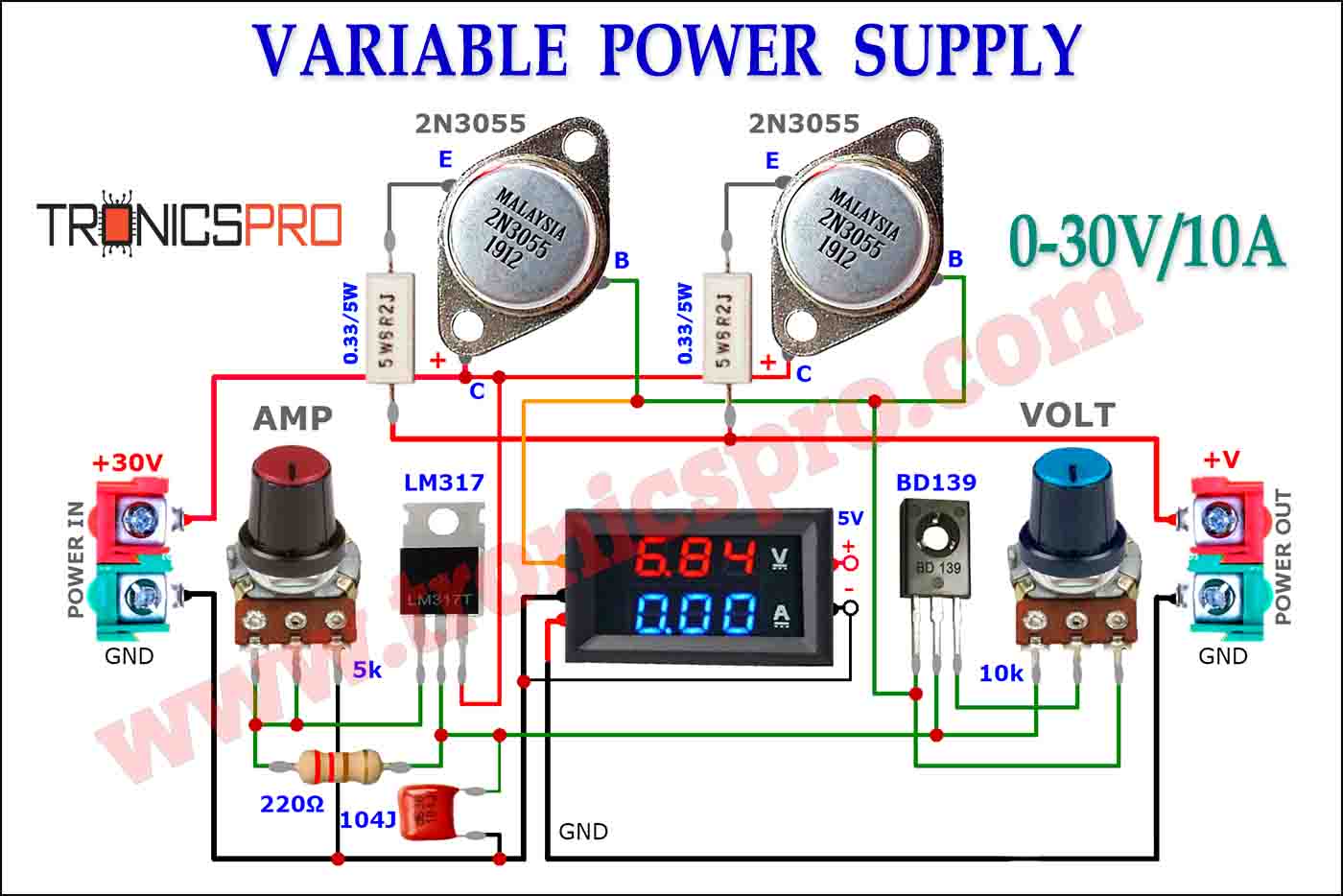
- DC motor controllers
- Switching power supplies
- Relay and solenoid drivers
- Inverter circuits and UPS systems
- Complementary push-pull configurations
- Industrial control electronics
NPN Complementary Transistor
The NPN complementary transistor for the BD744 is the BD743. Both transistors share identical ratings in voltage, current, and power, but opposite conduction characteristics. When combined, they form a push-pull amplifier pair, which provides high efficiency, low distortion, and symmetrical signal amplification.
Equivalent Transistors and Alternatives
Comparison Summary: BD744 vs BD743
The BD744 vs BD743 comparison illustrates how these two transistors complement each other in design and operation. The BD744 is a PNP transistor, conducting when its base is more negative than the emitter, while the BD743 is an NPN transistor that conducts when the base is positive.
Both devices share identical electrical ratings: 45V collector-emitter voltage, 50V collector-base voltage, 20A collector current, and 90W dissipation, making them perfectly balanced for complementary push-pull circuits.
In amplifier designs, the BD743 manages the positive waveform while the BD744 handles the negative, delivering excellent linearity, high output power, and low crossover distortion. This dual arrangement ensures smooth audio reproduction, reliable power switching, and long-term stability even under thermal stress.
Frequently Asked Questions (FAQ)
What is the BD744 transistor used for?
The BD744 is used in audio amplifiers, DC motor drivers, and high-current power switches.
What package type does BD744 use?
It is a PNP silicon power transistor in a TO-220 package designed for high current and medium voltage.
What is the BD744 pin configuration?
The BD744 has a Base–Collector–Emitter (BCE) pin sequence.
What is the complementary transistor for BD744?
The BD743 is the NPN complementary transistor to BD744.
Can I use BD712 instead of BD744?
BD712 is lower in power and current capacity. It can substitute only in low-demand circuits but not in high-power amplifier designs.
Conclusion
The BD744 transistor is a reliable PNP power device suitable for a wide range of amplifier and power switching circuits. It pairs perfectly with the BD743 NPN transistor for high-performance complementary applications. With robust 20A current handling and 90W power dissipation, it ensures durability and stable operation in demanding environments such as industrial controls, amplifiers, and inverter systems.
Whether used independently or as part of a matched pair, the BD744 remains a trusted component for engineers and audio designers alike.
Datasheet & Pinout of BD744 NPN Transistor
Click the following Button to download the datasheet of BD744 Transistor :
More projects, You may like:
- Video Transmitter DIY Homemade FM Radio Transmitter
- Adjustable Power Supply DIY Battery Charger
- 12V-220V 500 Watt inverter DIY Homemade
- MPPT Solar Charge Controller DIY Homemade
- DIY LA4440 bass amplifier homemade
For more project and circuit diagrams, you can go through the Schematics in the main menu where you can find many interesting projects and circuit diagrams like audio amplifier circuits, voltage booster circuit, battery charger circuit and timer circuits etc., which are all beginner circuit projects. Feel free to check them out!
Thank you for visiting the article
You may also like:
![BD138 PNP Transistor Datasheet]()
BD138 PNP Transistor Pinout Datasheet
![MJ15004 datasheet pinout]()
MJ15004 Pinout Equivalent Applications, Datasheet
![bf420 datasheet pinout equivalent specification application transistor]()
BF420 Pinout, Equivalent, Application, Datasheet
![2n4123 datasheet pinout]()
2N4123 Pinout, Equivalent, Application, Datasheet
![bd546 datasheet pinout]()
BD546 Pinout, Equivalent, Applications, Datasheet
![BD176 PNP Transistor Datasheet]()
BD176 PNP Transistor Pinout Datasheet
![TIP50 NPN Transistor Datasheet Pinout]()
TIP50 High Power NPN Transistor Datasheet
![2n2905 datasheet pinout]()
2N2905 Pinout, Equivalent, Application, Datasheet