The PN100 NPN transistor is a general-purpose semiconductor device commonly used in low to medium power electronic circuits. This article presents an overview of its electrical characteristics, applications, operating behavior, and detailed pn100 pinout information to support proper use in practical circuit designs.

Introduction
The PN100 is an NPN bipolar junction transistor designed for signal amplification and switching applications. It is widely used in control circuits, driver stages, and general electronic projects where stable performance and compact size are preferred. The TO-92 package makes the PN100 easy to handle and suitable for high-density PCB layouts.
Its consistent electrical behavior and ease of biasing make the PN100 a practical choice for both educational and professional electronics designs.

PN100 Pinout

Understanding the PN100 Pinout Configuration
The PN100 pinout follows an Emitter–Base–Collector (E-B-C) arrangement when viewed from the flat side of the TO-92 package. Correct pin identification is essential for proper circuit operation.
| Pin# | Pin Name |
|---|---|
| 1 | Emitter |
| 2 | Base |
| 3 | Collector |
PN100 Key Features
- General-purpose transistor design
- Stable switching and amplification behavior
- Compact TO-92 package
- Suitable for low power electronic circuits
- Easy integration into PCB layouts
- Reliable performance in everyday applications
Characteristics / Specifications
- Transistor Type: NPN
- Package Type: TO-92
- Collector-Emitter Voltage (VCE): 45V
- Collector-Base Voltage (VCB): 75V
- Emitter-Base Voltage (VEB): 6V
- Continuous Collector Current (IC): 500mA
- Power Dissipation (PD): 625mW
- Maximum Junction Temperature (Tj): 150°C
- Storage Temperature Range (Tstg): -55°C to 150°C
More Circuit Layouts

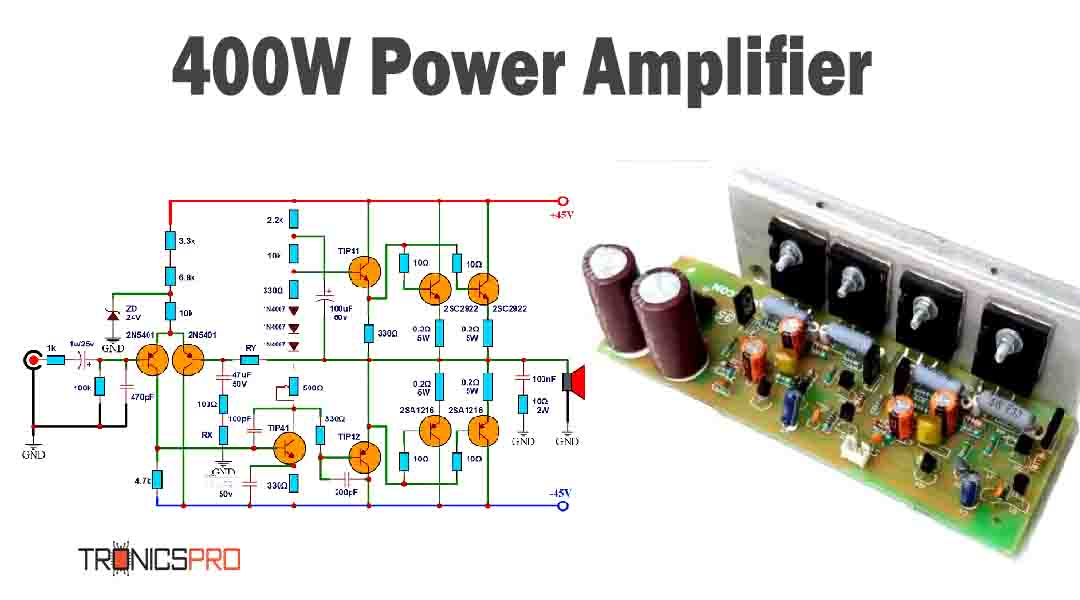





Key Applications of PN100 NPN Transistor
- Signal amplification circuits
- Low power switching applications
- Driver stages
- Control and logic circuits
- Educational and DIY electronics projects
- Consumer electronic devices
Equivalent of PN100 NPN Transistor
The following transistors can be considered as alternatives to the PN100 with suitable design adjustments:
Working Principle of PN100
The PN100 operates as a bipolar junction transistor in which a small base current controls a larger current flowing between the collector and emitter. When the base-emitter junction is forward biased, charge carriers move through the device, enabling amplification or switching action.
This operating behavior allows the PN100 to function effectively in signal control and low power switching circuits.
Frequently Asked Questions (FAQ)
Q1: What package is used for the PN100 transistor?
The PN100 is available in a TO-92 package.
Q2: What is the PN100 pinout order?
The pin configuration is Emitter, Base, and Collector (E-B-C).
Q3: Can PN100 be used as a switch?
Yes, it is commonly used in low power switching applications.
Q4: Is PN100 suitable for beginner projects?
Yes, its simple handling and stable behavior make it suitable for learning and prototyping.
Conclusion
The PN100 NPN transistor is a practical and versatile component for low power electronic applications. With a clearly defined pn100 pinout, reliable operating characteristics, and broad application range, it is well suited for amplification, switching, and educational circuit designs.
Datasheet of PN100 NPN Transistor
Click the following Button to download the datasheet of PN100 Transistor :
More projects, You may like:
- Video Transmitter DIY Homemade FM Radio Transmitter
- Adjustable Power Supply DIY Battery Charger
- 12V-220V 500 Watt inverter DIY Homemade
- MPPT Solar Charge Controller DIY Homemade
- DIY LA4440 bass amplifier homemade
For more project and circuit diagrams, you can go through the Schematics in the main menu where you can find many interesting projects and circuit diagrams like audio amplifier circuits, voltage booster circuit, battery charger circuit and timer circuits etc., which are all beginner circuit projects. Feel free to check them out!
Thank you for visiting the article.
You may also like:
![bd249 datasheet pinout]()
BD249 Pinout, Equivalent, Applications, Datasheet
![mje802 datasheet pinout equivalent specification application npn transistor]()
MJE802 Pinout, Equivalent Application Datasheet
![tip112 datasheet pinout equivalent specification application mosfet n-channel]()
TIP112 Pinout, Equivalent, Application, Datasheet
![TIP131 NPN Power Transistor Datasheet]()
TIP131 NPN Power Transistor Pinout Datasheet
![bd744 datasheet pinout]()
BD744 Pinout, Equivalent, Applications, Datasheet
![2n6100 datasheet pinout equivalent specification]()
2N6100 Pinout, Equivalent, Application, Datasheet
![bd250 datasheet pinout]()
BD250 Pinout, Equivalent, Applications, Datasheet
![2n5680 datasheet pinout]()
2N5680 Pinout, Equivalent, Application, Datasheet